
 Comergent
Shopify's Spring '26 Edition, Explained: What Actually Changed (And What to Do Now)
The short answer
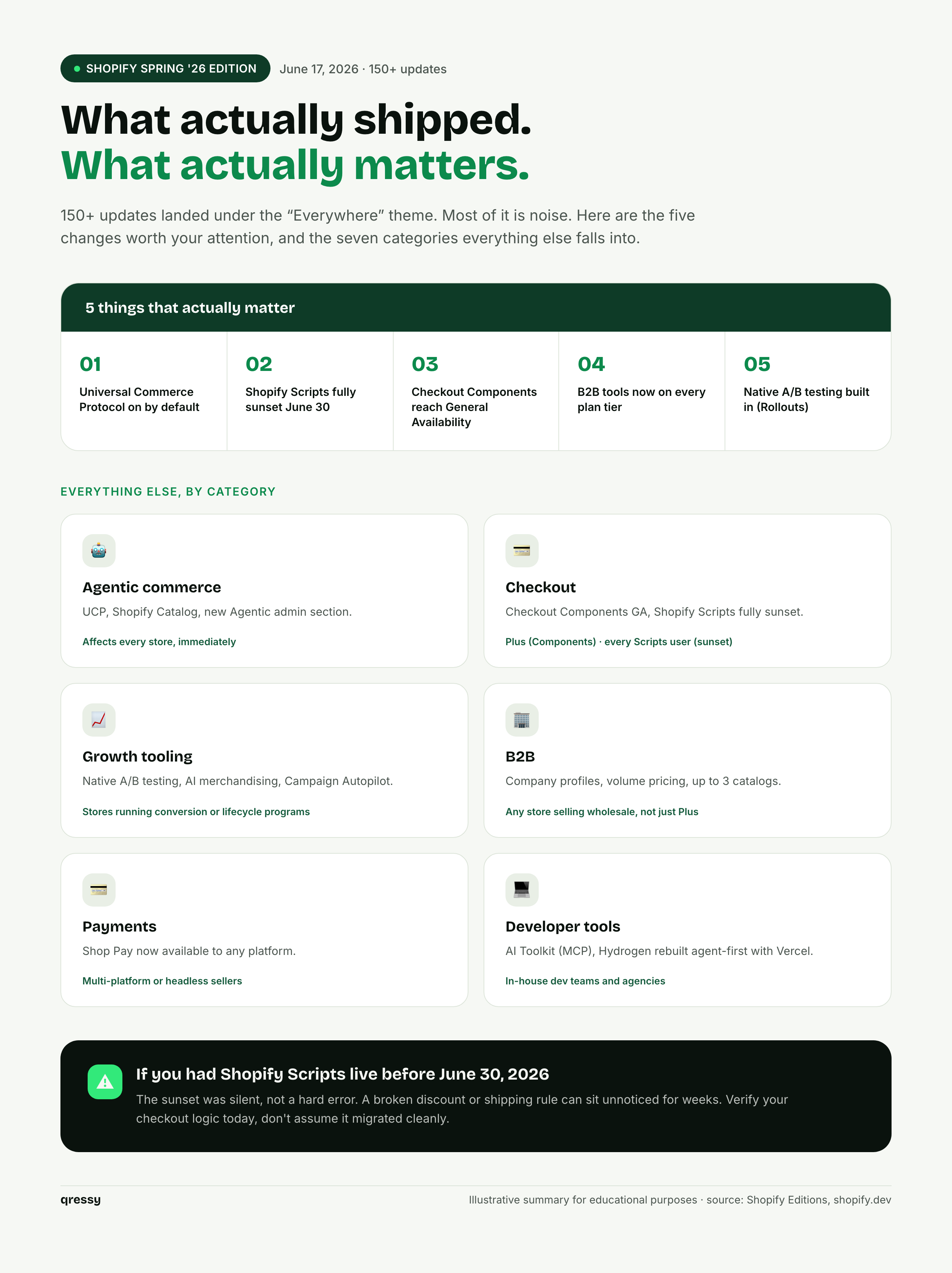
Shopify's Spring '26 Edition (publicly nicknamed the 'Everywhere Edition') shipped on June 17, 2026, with more than 150 updates. If you only read one paragraph of this article, read this one: the headline number is marketing, not a to-do list. For most stores, five things matter: the Universal Commerce Protocol is now on by default, Shopify Scripts stopped running entirely on June 30, 2026, Checkout Components reached General Availability for Plus, B2B features moved onto every plan tier, and native A/B testing (Rollouts) is now built in. Everything else is either a Plus-only refinement or a feature you'll adopt opportunistically, not urgently.
Check whether your Shopify Scripts are still running. The sunset was silent, not a hard error, so a broken discount or shipping rule from Scripts can sit unnoticed for weeks. Go to Settings, and if you had Scripts live before June 30, 2026, confirm the equivalent logic now exists as a Shopify Function, an app, or a native setting.
What is the Shopify Spring '26 Edition?
The Spring '26 Edition is Shopify's twice-yearly release cycle: a single coordinated drop of every product update the company has shipped since the previous Edition, announced by CEO Tobi Lütke. Spring '26 landed June 17, 2026, themed 'Everywhere,' and the through-line across the 150+ items is simple: Shopify wants your products sellable everywhere a customer already is, in a browser, in a physical store, inside a social app, or inside an AI assistant, rather than only on your storefront.
You'll see this Edition referred to as 'Summer '26' on a number of blogs and agency sites, purely because June reads as summer to a lot of writers. The official name, per Shopify's own editions page and press release, is Spring '26. Worth knowing if you're trying to search for the right documentation later.
| Category | What shipped | Who it actually affects |
|---|---|---|
| Agentic commerce | Universal Commerce Protocol on by default, Shopify Catalog, new Agentic admin section | Every store, immediately |
| Checkout | Checkout Components GA, Shopify Scripts fully sunset | Plus merchants (Components); every Scripts user (sunset) |
| Growth tooling | Native A/B testing (Rollouts), AI merchandising, Campaign Autopilot | Stores actively running conversion or lifecycle programs |
| B2B | Company profiles, volume pricing, up to 3 catalogs on every plan | Any store selling wholesale or B2B, not just Plus |
| Payments | Shop Pay available to any platform, not just Shopify stores | Multi-platform or headless sellers |
| Developer tools | AI Toolkit (MCP-based), Hydrogen rebuilt agent-first with Vercel | In-house dev teams and agencies |
| Retail | POS v11, in-store returns and pickup | Stores with physical locations |
Universal Commerce Protocol: what it actually is
The Universal Commerce Protocol (UCP) is an open standard, co-developed by Shopify and Google, that lets AI shopping agents (ChatGPT, Microsoft Copilot, Google AI Mode, Gemini, the Shop app) read a store's catalog, build a cart, and complete a purchase without a custom integration for each one. Every Shopify store now runs it by default.
Mechanically, it works a lot like robots.txt. Your store publishes a JSON capability profile at /.well-known/ucp. An AI agent requests that file, sees what your store supports (product discovery, cart, checkout, payment handlers, post-purchase actions like order status or returns), and negotiates the rest of the transaction using that shared vocabulary. UCP itself doesn't reinvent payments: each provider, Shopify, Google, a regional processor, publishes its own handler spec, and the agent picks whichever one your store advertises. It's built on standard REST and JSON-RPC transports, and interoperates with the other agent protocols already in the market (Google's AP2, Agent2Agent, and Anthropic's Model Context Protocol).
UCP and Shopify Catalog are only as good as your product data. Both pull from product metafields to answer agent queries accurately. If your metafields are empty, inconsistent, or copy-pasted placeholders, an AI agent can't surface your products correctly, no matter how 'enabled by default' UCP is. Clean, complete product data is now a discoverability requirement, not a nice-to-have.
For most merchants, there's nothing to configure here today. UCP being 'on by default' means you don't need a developer to flip a switch. What you do need is the same SEO discipline that's always mattered, real product titles, real descriptions, real structured attributes, just aimed at a machine reader instead of only a human one. If AI referral traffic is starting to show up in your analytics as an unlabeled bucket, that's this system already working; Comergent AI is a Shopify app we built specifically to track and optimize that channel.
Shopify Scripts is dead. Here's what to check right now.
If your store used Shopify Scripts for custom discounts, shipping rules, or payment method conditions, that code stopped executing on June 30, 2026. Editing or publishing new Scripts was already frozen from April 15, 2026 onward. If you're reading this after that date and haven't migrated, the honest answer is: some of your checkout logic has probably already been off for weeks, and it wouldn't have thrown an error to tell you.
Scripts don't fail loudly. A discount that silently stops applying, a shipping rule that silently reverts to default rates, doesn't generate a support ticket from your system. It generates one from a customer, or a quieter margin leak you only notice at month-end reconciliation. If you haven't explicitly verified your checkout logic since June 30, 2026, verify it today.
Shopify's own migration guide lays out three replacement paths, and which one applies depends entirely on what your Script actually did.
| If your Script did this... | Replace it with | Who should do the work |
|---|---|---|
| A standard percentage, BOGO, or fixed-amount discount | A native Shopify discount (Settings → Discounts) | You, no developer needed |
| A common shipping or payment rule (hide a method, free-shipping threshold, etc.) | A Shopify App Store app built on Shopify Functions | You, 15–30 minutes of setup |
| Custom logic specific to your catalog, tiers, or business rules | A custom Shopify Function | A developer or your Shopify agency |
The first two paths cover the majority of stores. It's the third row, genuinely custom logic tied to your specific catalog or pricing model, where most of the real migration risk sits, because a Function has to be written, tested against your actual discount edge cases, and deployed without a checkout outage. That's exactly the kind of work we do as part of Shopify Development engagements when a client's Scripts turn out to be load-bearing for their margins.
Checkout Components reaching General Availability
Checkout Components is now generally available for Shopify Plus. In practice, this finishes a multi-year shift in how Shopify lets you customize checkout: instead of theme-level Liquid hacks or Scripts, checkout customization now runs through a standardized component and Functions layer, the same architecture that just replaced Scripts for discount logic.
The practical upside is stability. Customizations built on Checkout Components survive Shopify's own platform updates instead of breaking every time checkout gets touched, which was the recurring failure mode with older theme-based hacks. The trade-off is that anything still running on the old customization approach needs a real migration plan, not a copy-paste fix, which is a natural pairing with a broader Shopify Plus upgrade conversation if you're not already there.
B2B and native A/B testing are no longer Plus-exclusive perks
Two changes matter here for standard Shopify merchants specifically, not just Plus. Company profiles, volume pricing, and up to three B2B catalogs are now available on every plan tier, not gated behind Plus. And native A/B testing (branded as Rollouts) is now built into Shopify directly, letting you test checkout and storefront changes without a third-party testing app layered on top.
If you've been paying for a CRO testing app purely for basic split-testing, or running a semi-manual wholesale ordering process because full B2B tooling felt like a Plus-only investment, both of those constraints just changed. This is exactly the kind of Editions update worth an actual audit rather than a reflexive adopt-it-or-ignore-it call, which apps still earn a subscription now that Shopify ships the core function natively.
What this Edition means if you're still deciding: Shopify or Shopify Plus?
Spring '26 narrows the gap on paper (B2B and A/B testing are no longer Plus-only) but widens it in practice for checkout. Checkout Components GA and the full agentic/UCP toolchain are landing fastest and deepest on Plus, and Plus still owns checkout extensibility, materially higher API limits, and multi-store management outright. If your growth is content- and catalog-led more than checkout-custom, standard Shopify with this Edition's new B2B and testing tools now covers more ground than it used to. If checkout customization or multi-entity B2B is central to your model, Plus remains the right tier, and this Edition makes that build more capable than it was in 2025.
The developer and headless side: AI Toolkit and Hydrogen
Two changes are aimed squarely at teams building custom Shopify experiences rather than store owners running the admin day to day. AI Toolkit is a Model Context Protocol plugin that brings live store data, roughly 14 admin tools, and Shopify's own documentation directly into AI coding assistants (Cursor, Claude Code, VS Code, Gemini CLI). Practically, that means a developer can ask their coding assistant a question about a specific store's live data or settings and get a grounded answer, instead of working from stale docs and generic Liquid examples.
Hydrogen, Shopify's headless storefront framework, was rebuilt 'agent-first' in partnership with Vercel and is now framework-agnostic, including support for Next.js. For teams already running headless builds, or considering one, that removes the old lock-in argument against Hydrogen (that it only played well with Remix) and makes a Next.js-based headless storefront a realistic, supported path rather than a workaround.
A realistic adoption framework, not a feature checklist
The most useful thing we've seen said about this Edition, repeated across Shopify's own community and independent agencies, is that the stores that benefit aren't the ones who adopt the most features. They're the ones who already had a clear owner for the specific work a feature accelerates. A new testing tool with nobody responsible for running tests is overhead, not leverage. Use the table below as a triage pass rather than a launch list.
- Confirm every pre-June-30 Shopify Script has a working replacement (native setting, app, or Function)
- Spot-check 10–15 product pages for empty or placeholder metafields before assuming UCP/Catalog is representing you well
- If you're paying for a basic A/B testing app, check whether native Rollouts now covers that use case
- If you sell wholesale on standard Shopify, check whether the new native B2B tools replace a manual process
- Checkout Components migration, if you're Plus and still on older checkout customization
- Whether your current app stack has functionality Shopify now ships natively (audit before renewing)
- Headless/Hydrogen with Next.js, if you were previously blocked by Remix-only support
- POS v11, unless you already run Shopify POS in a physical location
- AI Toolkit, unless you have an in-house or agency dev team actively building on Shopify
- Sidekick's new Klaviyo/Loop/Smile/Judge.me integrations, unless you already use those specific tools
Common mistakes stores are making with this Edition
- Treating the Scripts sunset as a future deadline when, for most readers of this article, it has already passed silently
- Assuming UCP being 'on by default' means AI discoverability is handled, without ever auditing product metafields
- Renewing CRO or A/B testing app subscriptions on autopilot without checking if Rollouts now covers the same job natively
- Adopting Checkout Components or AI Toolkit because they're new, with no one on the team actually assigned to use them
- Migrating Scripts one-for-one into custom Functions when a native Shopify feature or a free app would have done the job with zero code
Real example: what a Scripts migration actually looks like
We migrated Gasboys.co, a federally-legal THCA and hemp storefront, from WooCommerce to Shopify with state-by-state shipping restrictions and 21+ age verification built directly into checkout. That kind of jurisdiction-aware shipping and eligibility logic is precisely the category of rule that used to live in a Shopify Script, and now has to live in a Shopify Function. The lesson that generalizes: any store with legal, tax, or compliance logic wired into checkout should treat the Scripts sunset as a compliance review, not just a technical migration.
“Managed to migrate our entire store without any data loss or downtime.”
Gasboys.co, 5-star Shopify Partner review, December 2025
When to bring in a Shopify agency for this Edition
Your Scripts encoded real business logic (tiered wholesale pricing, jurisdiction-based rules, loyalty-linked discounts) rather than a simple percentage-off. You're on Plus and still running pre-Components checkout customizations. You want UCP and Shopify Catalog to actually represent your catalog well, which is a data and content project, not a settings toggle. Or you're evaluating whether this Edition changes your Shopify vs. Shopify Plus decision and want that scoped against your actual roadmap rather than a generic feature list.
- Shopify Development services
- Migrate to Shopify services
- Shopify Plus vs. Shopify: Which Plan Does Your Store Need?
- Shopify vs. WooCommerce: How Do They Actually Compare on SEO?
- What Is Generative Engine Optimization (GEO)?
- Marketing & conversion services
- Comergent AI: AEO for Shopify stores
- WooCommerce to Shopify Migration: A Practical Checklist
Frequently asked questions
It's Shopify's twice-yearly coordinated product release, announced June 17, 2026, bundling 150+ updates under the theme 'Everywhere.' It's officially called Spring '26, though many blogs mislabel it Summer '26 because of the June date.
Spring '26 is the official name, confirmed on Shopify's own editions page and press release. 'Everywhere Edition' is the nickname/theme, not a season name. Third-party coverage calling it Summer '26 is incorrect.
Shopify Scripts stopped executing entirely on June 30, 2026. Editing or publishing new Scripts was frozen from April 15, 2026. Any discount, shipping, or payment logic still running on Scripts needs to be migrated to a native feature, an app, or a Shopify Function.
Manually test every discount, shipping rule, and payment condition you previously built with Scripts. The sunset doesn't throw a visible error; broken logic just silently stops applying, so the only reliable check is testing checkout behavior directly.
Shopify Functions. Depending on what your Script did, you may not need custom code at all: standard discounts often map to native Shopify settings, common shipping/payment rules are often covered by a free App Store app, and only genuinely custom logic needs a developer-built Function.
UCP is an open standard, co-developed by Shopify and Google, that lets AI shopping agents like ChatGPT, Copilot, and Gemini discover a store's catalog and complete purchases. It's enabled by default on every Shopify store as of Spring '26.
Your store publishes a JSON capability profile at /.well-known/ucp, similar to how robots.txt works for search crawlers. AI agents read that file to see what your store supports, then negotiate discovery, cart, checkout, and post-purchase actions using a shared protocol.
No. UCP is on by default for every Shopify store. What actually needs work is your product data: UCP and Shopify Catalog pull from product metafields, so incomplete or placeholder metafields will make your products harder for AI agents to represent accurately.
Shopify Catalog standardizes and enriches your product data so it can be served directly to AI shopping surfaces (ChatGPT, Microsoft Copilot, Google AI Mode, Gemini, the Shop app), functioning as the data layer underneath UCP-based agent commerce.
Checkout Components reached General Availability for Shopify Plus specifically. Standard Shopify merchants get other Spring '26 updates (B2B tools, native A/B testing) but Checkout Components remains a Plus capability.
No, and this is one of the more overlooked changes in Spring '26. Company profiles, volume pricing, and up to three B2B catalogs are now available on every Shopify plan tier, not gated behind Plus.
Rollouts is Shopify's native A/B testing feature introduced in Spring '26, letting merchants test storefront and checkout changes without installing a third-party testing app.
Check first whether Rollouts covers your actual use case (test types, reporting depth, statistical methodology) before cancelling anything. For straightforward split tests, it likely does; for advanced multivariate testing, verify feature parity first.
Yes, as of Spring '26. Shop Pay is now available to any platform or business, not just Shopify-hosted stores, giving non-Shopify sellers access to Shop Pay's existing user base and one-click checkout.
AI Toolkit is a Model Context Protocol (MCP) plugin that connects live store data, about 14 admin tools, and Shopify's documentation directly into AI coding assistants like Cursor, Claude Code, VS Code, and Gemini CLI, aimed at developers building on Shopify.
Not anymore. Hydrogen was rebuilt 'agent-first' in partnership with Vercel in Spring '26 and is now framework-agnostic, including support for Next.js, removing the previous Remix-only constraint.
Partially. B2B and native A/B testing are no longer Plus-exclusive, narrowing the gap for content- and catalog-led stores. But checkout extensibility, API limits, and multi-store management, plus the deepest Checkout Components rollout, still favor Plus for checkout-heavy or multi-entity businesses.
Verify your Shopify Scripts replacements are actually working, since that sunset already passed silently for most stores. After that, audit product metafields for AI/UCP readiness, then evaluate whether any paid apps now duplicate a native Shopify feature.
Only if you had active Shopify Scripts before June 30, 2026, and haven't migrated them. Stores that never used Scripts, or that migrated before the deadline, aren't affected. The risk is specifically silent, unmigrated Scripts.
We handle Scripts-to-Functions migrations (especially where the original logic involved real business rules like compliance or tiered pricing), Checkout Components upgrades for Plus, product data cleanup for AI/UCP readiness, and the broader Shopify Development and Migrate to Shopify work these Editions changes tend to surface.