Mastering Shopify Web Development: A Comprehensive Guide for Merchants and Aspiring Developers
Neeraj Matta
Apr 14, 2025
22 min read
Updated: Jun 3, 2025
Mastering Shopify Web Development: A Comprehensive Guide for Merchants and Aspiring Developers
In today's competitive e-commerce landscape, the expertise of a skilled Shopify web developer can be the difference between an online store that merely exists and one that thrives. Shopify has emerged as a leading e-commerce platform, powering over 2 million businesses worldwide, and with this growth comes an increasing demand for specialized developers who understand its unique architecture and capabilities.
Shopify web developers are professionals who specialize in creating, customizing, and optimizing online stores built on the Shopify platform. They combine technical prowess with e-commerce knowledge to transform business requirements into fully functional digital storefronts that not only look appealing but drive measurable business results.
Whether you're a business owner looking to hire the right developer for your project, or an aspiring web professional considering specialization in Shopify, this comprehensive guide will provide everything you need to know. We'll explore the essential skills of Shopify developers, how to find and hire the right talent, what costs to expect, the path to becoming a Shopify developer yourself, and best practices for successful development projects.
Table of Contents
What is a Shopify Web Developer?
Essential Skills of Expert Shopify Developers
Types of Shopify Web Developers
When to Hire a Shopify Web Developer
How to Find and Hire the Right Developer
Cost of Hiring Shopify Web Developers
Working Successfully with Shopify Developers
How to Become a Shopify Web Developer
Career Path and Opportunities
Best Practices for Shopify Development Projects
Frequently Asked Questions
What is a Shopify Web Developer?
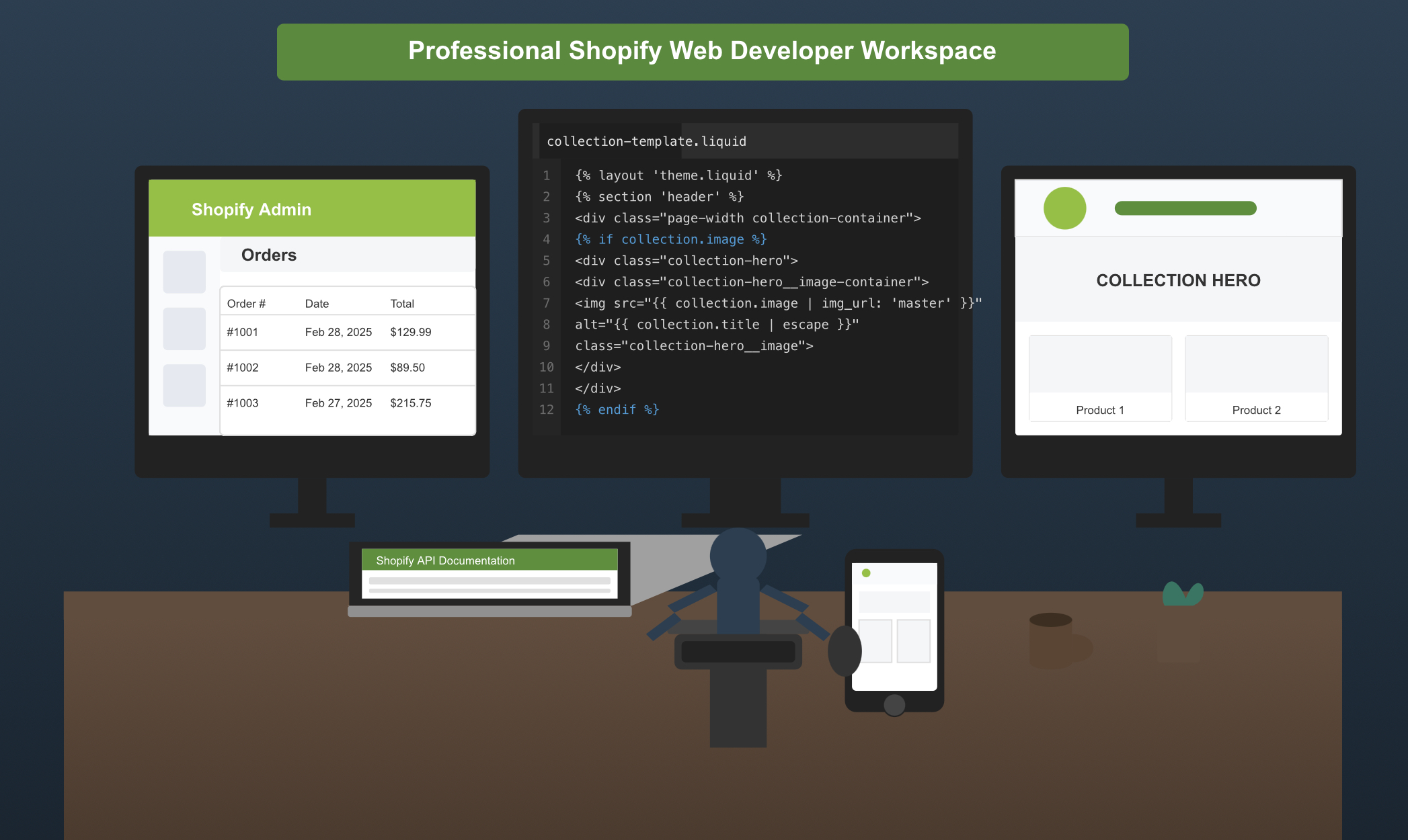
A Shopify web developer is a specialized tech professional who focuses on building and customizing online stores using the Shopify e-commerce platform. Unlike general web developers, Shopify developers have specific knowledge of the platform's unique architecture, capabilities, and best practices.
Core Responsibilities
Shopify web developers typically handle:
Store Setup and Configuration: Establishing the technical foundation of Shopify stores
Theme Development and Customization: Creating the visual experience and user interface
Custom Functionality Implementation: Building specialized features beyond standard options
App Development: Creating custom applications for specific business needs
Third-Party Integrations: Connecting Shopify with other business systems
Mobile Expertise: Ensuring excellent smartphone shopping experiences
The Impact of Quality Shopify Development
The difference between average and excellent Shopify development is significant:
Conversion Rate Improvement: Well-developed stores turn more visitors into customers
Brand Differentiation: Custom development creates distinctive experiences
Operational Efficiency: Proper integration streamlines business processes
Scalability: Professional development supports business growth
Customer Experience Enhancement: Thoughtful development improves satisfaction
Technical Stability: Expert implementation reduces errors and downtime
Competitive Advantage: Superior execution outperforms standard setups
Long-term Value: Quality development provides sustainable results
A skilled Shopify web developer doesn't just write code—they create digital commerce experiences that drive business success through technical excellence and strategic implementation.
Types of Shopify Web Developer
Understanding the skill set that defines quality Shopify developers helps in evaluation and hiring.
Technical Skills
Core technical capabilities include:
HTML/CSS Mastery: Fundamental web languages for structure and styling
JavaScript Proficiency: Essential for interactive elements and functionality
Liquid Expertise: Shopify's template language that powers themes
Client Collaboration: Working effectively with stakeholders
Requirements Gathering: Understanding business needs
Attention to Detail: Ensuring quality implementation
Continuous Learning: Staying current with platform changes
The most effective Shopify developers combine technical expertise with business understanding and communication skills. This comprehensive skill set enables them to create stores that are not only technically sound but strategically aligned with business objectives.
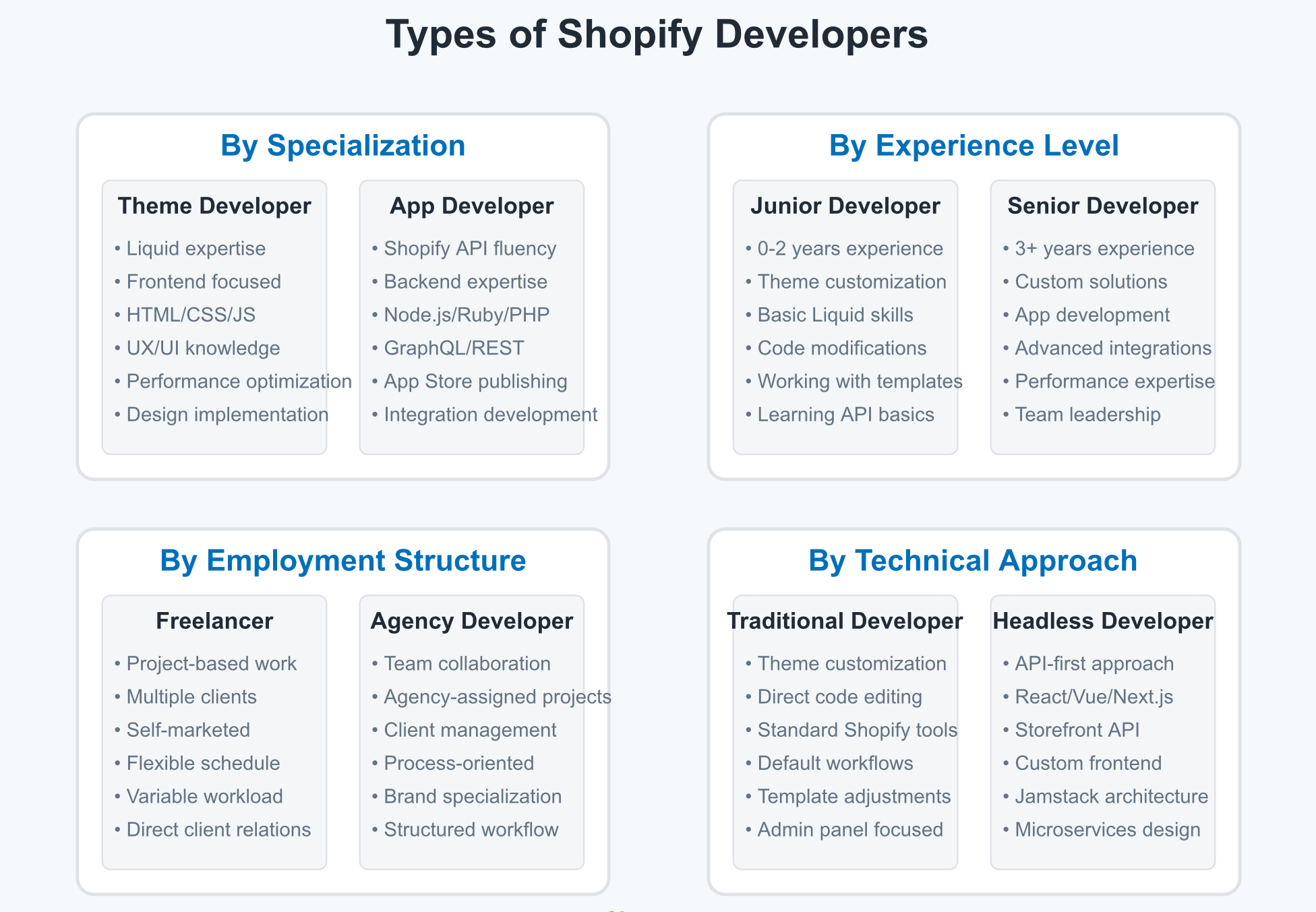
Types of Shopify Web DevelopersTypes of Shopify Web Developers
Understanding the different categories of Shopify developers helps find the right match for specific needs.
By Specialization
Developers often focus on particular aspects:
Theme Developers: Specialize in creating and customizing Shopify themes
App Developers: Focus on building custom Shopify applications
Frontend Specialists: Experts in user interface and experience
Full-Stack Developers: Handle both frontend and backend development
Integration Experts: Specialize in connecting systems with Shopify
Optimization Specialists: Focus on performance and conversion
Migration Developers: Expert at transitioning from other platforms
Maintenance Specialists: Focus on ongoing support and updates
By Experience Level
Developer capabilities vary by expertise:
Junior Developers: Early-career professionals with basic Shopify skills
Mid-Level Developers: Experienced professionals with proven projects
Senior Developers: Highly experienced experts with advanced capabilities
Shopify Experts: Developers officially recognized by Shopify
Shopify Plus Partners: Specialized in enterprise-level development
Shopify Solution Architects: Strategic development planners
By Employment Structure
Developers work under various arrangements:
Freelance Developers: Independent professionals working directly with clients
Agency Developers: Employees of development or digital marketing agencies
In-House Developers: Full-time employees dedicated to a single business
Remote Developers: Work from different geographic locations
Local Developers: Based in the same area as the client
Offshore Developers: Located in different countries, often for cost advantages
By Industry Focus
Some developers specialize in specific sectors:
Fashion and Apparel Specialists
Food and Beverage Experts
B2B Commerce Developers
Digital Product Specialists
Subscription Business Experts
Multi-channel Retail Developers
High-Volume Store Specialists
Luxury Brand Developers
By Technical Approach
Different development philosophies:
Custom Code Specialists: Focus on bespoke development
Finding a developer whose specialization aligns with your specific business needs often leads to better results. Most successful projects match not only technical skills but also industry experience, work arrangement preferences, and development philosophy.
When to Hire a Shopify Web Developer
Understanding when professional development help is needed saves time and resources.
New Store Creation
Professional development makes sense when:
Launching a Brand-Focused Store: Creating distinctive shopping experiences
Implementing Custom Functionality: Building unique features
Customer Complaints: Receiving feedback about store usability
A fashion retailer struggled for months with product variant management before hiring a Shopify developer. The professional implementation took just two weeks and increased their conversion rate by 58% by simplifying the selection process for customers.
How to Find and Hire the Right Developer
Strategies for identifying and securing quality Shopify development talent.
Where to Find Shopify Developers
Effective sourcing channels:
Shopify Experts Marketplace: Official platform directory
Freelance Platforms: Upwork, Fiverr, Toptal, etc.
Agency Directories: Clutch, DesignRush, Agency Spotter, etc.
LinkedIn: Professional networking and job posting
GitHub: Code repositories and developer profiles
Shopify Partner Directory: Official partner listings
Communication Ability: Clear explanation of concepts
Problem-Solving Approach: How challenges are addressed
Development Process: Methodology and organization
The Hiring Process
Steps for finding the right developer:
Define Project Requirements: Document specific needs
Create Detailed Brief: Outline project scope and expectations
Research Potential Candidates: Identify qualified developers
Review Portfolios and Experience: Evaluate past work
Conduct Interviews: Assess technical and communication skills
Check References: Verify past performance
Request Proposals: Get detailed approaches and estimates
Evaluate Cultural Fit: Assess working style compatibility
Make Selection: Choose the best candidate
Formalize Agreement: Create clear contract
Effective Interview Questions
Insightful questions for evaluation:
"Can you walk me through your development process for Shopify projects?"
"What recent Shopify projects have you completed that are similar to mine?"
"How do you handle responsive design and mobile optimization?"
"What approach do you take for Shopify performance optimization?"
"How do you manage project timelines and communication?"
"What are the most common challenges you encounter in Shopify development and how do you address them?"
"How do you stay current with Shopify platform changes?"
"Can you explain how you would implement in my project?"
Red Flags to Watch For
Warning signs during the hiring process:
Vague Answers: Lack of specific responses to technical questions
Limited Portfolio: Few relevant Shopify examples
Poor Communication: Slow or unclear responses
No References: Inability to provide client testimonials
Unrealistic Promises: Guarantees that seem too good to be true
Significantly Low Pricing: Rates well below market averages
Lack of Process: No clear development methodology
Outdated Knowledge: Unfamiliarity with current Shopify features
Creating Effective Project Briefs
Components of a comprehensive brief:
Business Background: Company overview and objectives
Project Goals: Specific outcomes desired
Target Audience: Customer demographic information
Functional Requirements: Detailed feature list
Design Guidelines: Brand and visual direction
Technical Specifications: Platform details and integrations
Content Requirements: Product and page information
Timeline Expectations: Key milestones and deadlines
Budget Parameters: Investment range and constraints
Success Metrics: How results will be measured
Finding the right Shopify developer requires thorough evaluation and clear communication. As one e-commerce manager noted: "We interviewed eight developers before selecting our partner. The extensive vetting process saved us countless headaches down the road and led to a relationship that's been invaluable for our business growth."
Cost of hiring Shopify Web Developers
Understanding the investment required for quality Shopify development.
Pricing Models
Common payment structures:
Hourly Rates: Payment based on time spent
Fixed Project Fees: Predetermined cost for defined scope
Retainer Arrangements: Ongoing monthly service fee
Milestone-Based Payments: Tied to completion phases
Value-Based Pricing: Fees linked to business results
Hybrid Models: Combining different approaches
Typical Rate Ranges
General pricing expectations by provider type:
Freelance Developers
Junior Developers: $25-$75 per hour
Mid-Level Developers: $75-$125 per hour
Senior Developers: $125-$200+ per hour
Agency Developers
Small Agencies: $75-$150 per hour
Mid-Size Agencies: $100-$200 per hour
Enterprise Agencies: $150-$300+ per hour
Project-Based Pricing
Theme Customization: $1,500-$10,000
Custom Theme Development: $10,000-$50,000
Custom App Development: $5,000-$50,000+
Store Migration: $5,000-$100,000+
Integration Development: $2,500-$25,000 per system
Ongoing Support
Basic Maintenance: $500-$2,000 monthly
Growth-Focused Retainer: $2,000-$10,000+ monthly
Geographic Pricing Factors
Regional cost differences:
North America: Typically highest rates
Western Europe: Premium pricing
Eastern Europe: Moderate rates with strong skills
Southeast Asia: Lower rates with varying expertise
South Asia: Generally lowest rates
Latin America: Moderate pricing
Australia/New Zealand: Premium pricing
Africa: Emerging market with varying rates
Cost Factors
Elements that influence pricing:
Developer Experience: More seasoned professionals charge more
Stock Theme Customization: Modify existing themes instead of building from scratch
App Solutions: Use existing apps for standard functionality
Template Starting Points: Begin with established frameworks
Timely Feedback: Prompt responses prevent delays
Feature Prioritization: Focus on high-impact elements
A home goods retailer initially chose a developer based solely on lowest price, saving $5,000, but ultimately spent an additional $12,000 fixing issues and rebuilding problematic areas. Their advice: "The least expensive option often costs more in the long run. Value experience and quality over initial price."
Working Successfully with Shopify Developers
Best practices for effective collaboration throughout the development process.
Feedback Sharing: Provide testimonials and reviews
A successful e-commerce director shared: "The difference between our most successful and most problematic developer relationships wasn't technical skill—it was communication quality. Clear expectations, regular updates, and mutual respect matter more than you might think."
How to Become a Shopify Web Developer
The path to establishing yourself as a Shopify development professional.
Learning Path Fundamentals
Essential first steps:
Web Development Basics: Master HTML, CSS, JavaScript
Custom Functionality: Building specialized features
App Development: Creating Shopify applications
Integration Development: Connecting systems
Performance Optimization: Speed improvements
Advanced Techniques: Headless, PWA, etc.
Architecture Design: Planning complex solutions
Building Your Portfolio
Showcasing your expertise:
Personal Demo Store: Create your own examples
Open Source Contributions: Share code publicly
Case Studies: Document problem-solving
Before/After Comparisons: Show improvements
Performance Metrics: Highlight speed enhancements
Process Documentation: Explain your approach
Specialized Demos: Show unique capabilities
Result Demonstrations: Business impact stories
Getting Your First Clients
Breaking into the market:
Freelance Platforms: Upwork, Fiverr, etc.
Shopify Partner Directory: Official listings
Local Business Networking: Community connections
Social Media Presence: Showcase expertise
Content Creation: Tutorials and guides
Competitive Pricing: Entry-level rates
Collaborative Projects: Partner with designers
Specialized Focus: Target specific niches
Professional Development
Growing your career:
Shopify Partner Program: Official recognition
Certification Pursuit: Formal credentials
Continuous Learning: Stay current with changes
Community Involvement: Participate in discussions
Networking: Build professional connections
Specialization: Develop unique expertise
Process Refinement: Improve workflow efficiency
Business Skills: Develop client management abilities
Many successful Shopify developers began with unrelated web development backgrounds before specializing. One developer shared: "I transitioned from WordPress to Shopify over six months of dedicated learning. The investment paid off within a year as Shopify clients typically have bigger budgets and ongoing development needs."
Career Path and Opportunities
The professional landscape for Shopify web developers.
Market Demand
Current opportunity landscape:
Growing Merchant Base: Over 2 million active Shopify stores
Talent Shortage: Demand exceeds qualified supply
Specialization Premium: Higher rates for focused expertise
Global Talent Competition: Worldwide developer market
Remote Work Normalization: Location-independent careers
AI and Automation Impact: Changing skill requirements
Low-Code Evolution: Shifting development approaches
Integration Complexity: More connected systems
A Shopify developer who specialized in performance optimization shared: "When I narrowed my focus to speed improvement instead of general development, my rates increased by 60% while my project scope actually decreased. Specialists command premium rates in this ecosystem."
Best Practices for Shopify Development Projects
Guidelines for successful implementation and collaboration.
Project Planning Best Practices
Setting strong foundations:
Begin with Business Goals: Focus on objectives, not features
Create Detailed Requirements: Document specific needs
Establish Clear Timelines: Set realistic deadlines
Define Communication Protocols: Plan regular updates
Set Success Metrics: Define how results will be measured
Following these best practices creates more successful Shopify development projects that deliver business value, technical excellence, and positive working relationships between merchants and developers.
Frequently Asked Questions
How much does it cost to hire a Shopify web developer?
Answer
: Costs vary based on experience level, project complexity, and geographic location. Freelance Shopify developers typically charge $25-$200+ per hour, with junior developers at the lower end and senior specialists at the higher end. Agency developers usually charge $75-$300+ per hour. For project-based pricing, theme customization typically costs $1,500-$10,000, custom theme development ranges from $10,000-$50,000, and custom app development starts around $5,000 and can exceed $50,000 for complex applications. Ongoing maintenance retainers generally cost $500-$10,000 monthly depending on store complexity and support needs. The most important consideration is aligning the investment with your specific business requirements and expected returns.
How long does it take to become a Shopify web developer?
Answer
: The timeline varies based on your existing web development experience. For experienced web developers familiar with HTML, CSS, and JavaScript, you can develop basic Shopify skills in 1-3 months of focused learning and practice. Becoming proficient enough for professional work typically takes 3-6 months of dedicated study and project work. For beginners with no prior development experience, expect 9-12+ months to reach professional capabilities. Achieving senior-level expertise generally requires 2-4+ years of active Shopify development work. The key factors affecting this timeline are your learning consistency, project practice, and whether you focus exclusively on Shopify or divide attention between multiple platforms.
What's the difference between a Shopify web developer and a web designer?
Answer
: Shopify web developers focus on technical implementation, functionality, and code. They create the working structure of online stores, handle integrations with other systems, and build custom features using HTML, CSS, JavaScript, and Shopify's Liquid template language. Web designers, by contrast, focus on visual aesthetics, user experience, brand identity, and the overall look and feel. They create mockups, design systems, visual elements, and user interfaces that developers then implement. While some professionals possess both skill sets (designer-developers), most specialize in either development or design. Successful Shopify projects typically require both roles, working in collaboration to create stores that are both visually appealing and functionally robust.
Should I hire a freelancer or an agency for my Shopify development?
Answer
: This depends on your project complexity, budget, and support needs. Freelancers typically offer lower rates, more direct communication, and personal attention, making them suitable for smaller projects with clear scope. Agencies provide team resources, broader expertise, more structured processes, and ongoing support capacity, making them better for complex projects, tight deadlines, or situations requiring multiple specialists. Consider your internal capabilities, project timeline, budget constraints, and long-term support needs when deciding. Many businesses start with freelancers for smaller projects and migrate to agencies as their e-commerce operations grow more sophisticated and require ongoing development support.
What questions should I ask when hiring a Shopify web developer?
Answer
: Start with questions about their Shopify-specific experience: "What similar Shopify projects have you completed?" and "How long have you been working with the platform?" Then explore their technical approach: "How do you handle responsive design and mobile optimization?" and "What's your process for Shopify performance improvement?" Discuss project management: "What's your development workflow?" and "How do you communicate progress and handle feedback?" Inquire about potential challenges: "What limitations might we face with our requirements?" Finally, cover practical details: "What's your availability and timeline for our project?" and "How do you structure pricing and payments?" These questions help assess both technical capability and working relationship potential.
How do I maintain my Shopify store after development is complete?
Answer
: Most Shopify stores require regular maintenance including theme updates to ensure compatibility with platform changes, security patches, bug fixes, and performance monitoring. You should establish whether you'll handle basic updates internally or retain your developer for ongoing support. Many merchants establish maintenance agreements with their developers to cover routine needs while providing access to support when issues arise. For content updates like product changes, blog posts, and basic settings, your team can typically manage these after proper training. Technical maintenance like code updates, theme modifications, and integration management is best handled by development professionals. Budget approximately 15-20% of your initial development cost annually for maintenance and ongoing improvements.
How do I become a certified Shopify web developer?
Answer
: Shopify offers several certification paths through the Shopify Partner Academy. Start by joining the Shopify Partner Program, which is free and provides access to development stores and learning resources. Complete the foundational courses in the Partner Academy, which cover Shopify fundamentals. For development certification, focus on the "Theme Development" and "App Development" learning tracks. These lead to official certifications that verify your expertise. The certification process typically involves completing courses, passing assessments, and in some cases, submitting work examples. Being certified helps establish credibility with potential clients and can lead to being listed in the Shopify Experts marketplace. Beyond certification, build a strong portfolio of Shopify projects to demonstrate practical experience to potential clients.
!
Alt text: Frequently asked questions section about Shopify web developers with expandable answer panels and helpful icons
Conclusion: The Value of Expert Shopify Web Development
In the competitive world of e-commerce, the expertise of a skilled Shopify web developer can transform an ordinary online store into an exceptional shopping destination that drives business growth. The right developer brings more than just technical skills—they contribute strategic understanding, problem-solving capabilities, and platform-specific knowledge that creates measurable business impact.
For merchants and businesses, finding and working effectively with the right Shopify developer requires understanding the skills to look for, asking the right questions during evaluation, setting clear expectations, and maintaining productive communication throughout the project. The investment in quality development pays dividends through higher conversion rates, improved customer experiences, operational efficiency, and competitive differentiation.
For those considering a career as a Shopify web developer, the platform offers abundant opportunities in a growing ecosystem. With dedicated learning, practical project experience, and continuous skill development, you can build a rewarding career with flexibility, strong income potential, and ongoing professional growth.
As e-commerce continues evolving rapidly, Shopify developers play an increasingly crucial role in helping businesses navigate technological changes, implement innovative solutions, and create digital shopping experiences that meet rising customer expectations. Whether you're hiring a developer or becoming one yourself, understanding the landscape of Shopify web development provides valuable perspective on this dynamic, in-demand specialization.
Call to Action
For Businesses Seeking Developers:
Ready to find the perfect Shopify web developer for your project? Take these next steps:
Document Your Requirements: Clearly define what you need, including business goals and technical specifications
Create Your Project Brief: Prepare detailed information for potential developers
Research Qualified Candidates: Use the channels outlined in this guide
Begin Evaluation Process: Interview and assess potential partners
Plan Your Development Roadmap: Create a clear timeline and milestone plan
For Aspiring Shopify Developers:
Want to build your career as a Shopify web developer? Start with these actions:
Begin Learning Fundamentals: Explore Shopify Partner Academy and documentation
Set Up a Development Environment: Create test stores and local workflow
Build Practice Projects: Create portfolio examples
Join Developer Communities: Connect with other Shopify developers
Create Your Professional Presence: Establish your portfolio and service offerings
The time invested in either finding the right Shopify developer or becoming one yourself can lead to exceptional e-commerce success in today's digital marketplace.
This article was last updated in February, 2025, and reflects current Shopify web development practices and market conditions.





Comments